
Tax Tip Tuesday: Charitable Giving Documentation Rules - Keep Your Deduction Safe

Most people think a charitable deduction comes from writing the check. To the IRS, it comes from the paperwork. A gift can be completely genuine and still be denied if you can’t prove it. With Giving Tuesday on December 1 and year-end about three months away, now is the time to set up your records, not next April.
Step 1: Confirm the Charity Qualifies
• Only gifts to qualified organizations are deductible. Check any charity you’re unsure about using the IRS Tax Exempt Organization Search.
• Gifts to individuals, crowdfunding pages for a specific person, and political campaigns are not deductible, no matter how worthy the cause.
Step 2: Match Your Records to the Gift
Cash gifts under $250
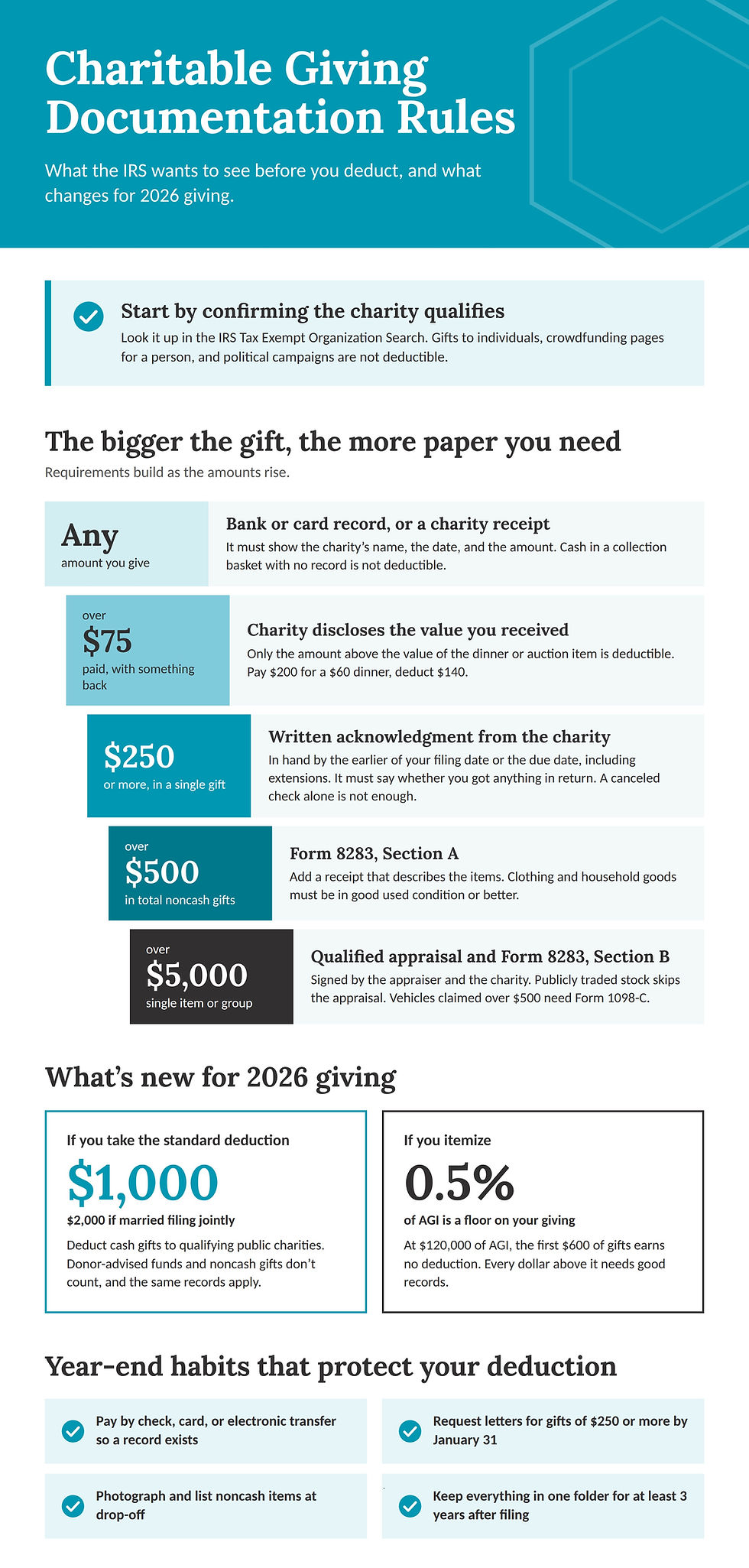
Cash in a collection basket with no record is not deductible. You need a bank record (canceled check, bank or credit card statement, or electronic payment confirmation) or a receipt from the charity showing the charity’s name, the date, and the amount.
Any single gift of $250 or more
You need a contemporaneous written acknowledgment from the charity. It must state:
• The charity’s name and the amount of cash (or a description of donated property; the charity doesn’t value it for you)
• Whether the charity gave you any goods or services in return
• If it did, a description and good-faith estimate of their value
“Contemporaneous” means you have it in hand by the earlier of the date you file your return or the due date (including extensions). A canceled check alone does not satisfy this rule. Each gift is tested separately, so a $50 monthly gift does not need its own letter, but a year-end giving statement from the charity is the easiest way to document it.
When you receive something in return
If you pay more than $75 and get something back, such as a gala dinner or auction item, the charity must give you a written disclosure. Only the amount above the fair market value of what you received is deductible. Pay $200 for a dinner worth $60, and your deduction is $140.
Quick reference by gift type
Gift | Minimum records you need |
Cash, check, or card under $250 | Bank or credit card record, or a receipt from the charity, showing the charity’s name, the date, and the amount. |
Any single gift of $250 or more | Written acknowledgment from the charity in hand before you file (details above). |
Payment over $75 where you got something back | Charity’s written disclosure of the value of what you received. |
Noncash gifts, total under $500 | Receipt from the charity (or your own written record if none is possible) describing the items, date, and location. |
Noncash gifts, total over $500 | Everything above, plus Form 8283, Section A. |
Single item or group of similar items over $5,000 (other than publicly traded stock) | Qualified appraisal plus Form 8283, Section B, signed by the appraiser and the charity. |
Vehicle claimed at more than $500 | Form 1098-C (or equivalent acknowledgment) from the charity. |
Noncash gifts
Clothing and household items must be in good used condition or better. Take photos and keep an itemized list at drop-off, since you are responsible for determining the value.
Volunteering
The value of your time is never deductible. Unreimbursed out-of-pocket costs are, including mileage at the statutory rate of 14 cents per mile. Keep a simple mileage log.
What’s New for 2026 Giving
Non-itemizers: If you take the standard deduction, you can now deduct up to $1,000 ($2,000 if married filing jointly) of cash gifts to qualifying public charities. Donor-advised fund contributions and noncash gifts don’t count, and the same documentation rules apply.
Itemizers: Only giving above 0.5% of AGI is deductible. At $120,000 of AGI, the first $600 of gifts produces no deduction. With less room for error, every dollar above the floor needs to be well documented.
A Quick Example
Maria gives $1,200 online by credit card on December 28. In January she receives an email that simply says “Thank you for your gift.” Her card statement proves the payment, but because the gift is over $250, she also needs an acknowledgment stating whether she received anything in return. She has until she files to request a corrected letter, and asking in January is far easier than asking in April.
A Simple Year-End Recordkeeping System
1. Verify each charity’s status before you give.
2. Pay by check, card, or electronic transfer so a record exists.
3. Request acknowledgments for every gift of $250 or more, ideally by January 31.
4. Photograph and list noncash items at drop-off.
5. Log volunteer mileage as you go.
6. Keep everything in one folder, and retain it for at least three years after filing (longer if you are carrying over excess contributions).
Planning Takeaways
• Gather your records before you file, not after; the acknowledgment deadline is tied to your filing date.
• Large or noncash gifts may need appraisals and forms that take time to arrange, so plan them before year-end.
• Decide early whether you’ll itemize or take the new non-itemizer deduction, since it affects how you time and structure your giving.
Have questions about documenting your charitable gifts? Email us at info@mkhstaxgroup.com and we’ll help you get organized before year-end.


Comments